Explore New Mexico’s Local News Landscape
How to use the map
This map plots the locations of local news outlets serving New Mexico. These outlets meet our criteria for organizations providing ongoing, original, factual, local coverage.
The left hand menu can filter outlet visibility by a key variable (Medium, Language, Business Model, Impact Level). The lower left menu applies U.S. Census characteristics to counties.
Click X to close the menu. Click the arrow to open map in full page view.
To find outlets near you, drag or zoom to your region; select an outlet cluster or outlet. Choosing an outlet will highlight counties served by that outlet and provide a pop-up with interesting details.
The pop-up includes a “Community Impact Level.” This number, between 1-3, reflects that news outlet’s breadth and depth of local coverage.
For more context, read the full report!

What is the New Mexico News Map?
The New Mexico News Map is a public service project researching the availability and value of local news and information at the community level across the state.

A Collaborative Effort
This project is managed by media professionals and educators, including former UNM professor Michael Marcotte and current UNM journalism professor Gwyneth Doland, in partnership with the New Mexico Local News Fund, under Executive Director Rashad Mahmood.
Support comes from UNM’s Center for Regional Studies and Press Forward New Mexico. We also receive in-kind support from New Mexico PBS, UNM Communication & Journalism, and MVM Consulting.
Together, we’re mapping the state’s news ecosystem to better understand where journalism thrives —and where it needs support.

-
This report reveals the clearest picture yet of how local news works in New Mexico. It is a landscape characterized by vast news deserts, serious financial challenges, mounting technical pressures — and fertile patches where innovation and collaboration are thriving.
-
Nearly half of of New Mexico’s news outlets are based in just four metropolitan areas: Albuquerque/Rio Rancho, Santa Fe, Las Cruces and Farmington. Newsrooms outside the bigger cities are overwhelmingly small and under-resourced. Meanwhile, four counties — with a total area of nearly 14,000 square miles — have no local news outlets. Many communities on the eastern and southern borders of the state only get TV news produced in Texas; others rely on social media gossip or just word-of-mouth to know what’s happening in their towns.
Only two thirds of residents say have access to trustworthy local news.
Four counties have no local news outlet based there.
Eight counties have only one news outlet based there.
90% of outlets statewide have fewer than 10 full-time staff members.
75% of outlets statewide have fewer than five full-time staff members.
-
New Mexico prides itself on its multicultural heritage, but Native American and Spanish-speaking residents have limited access to news about their communities.
More than 500,000 New Mexico residents speak Spanish.
Only four outlets deliver news in Spanish.
More than 60,000 residents speak Diné (Navajo).
Only three outlets deliver news in Diné (Navajo).
60% of residents say local media “somewhat” reflect their community.
25% say local media do not reflect them at all.
-
Everyone agrees: the future is digital — but New Mexico is struggling to get there. Consumers told us they want to access trustworthy, comprehensive local coverage that’s delivered with the same technological ease they’re used to getting from national outlets. As more than half of New Mexicans now get their news online or through social media, residents say they’re not sure what to trust. And even in areas where broadband exists, most small news outlets lack the staff or tech skills to produce apps, podcasts and video streams.
One in three news outlets serves more than half its audience on digital platforms.
Social media is the most preferred source of news for New Mexicans.
Rural residents prefer social media three times as much as television or radio.
More than half of rural residents say they rarely or never find news about their communities on television.
62% say“not enough sources” is a barrier to accessing local news.
-
The newsrooms that survived the digital disruption of the past two decades are doing more with less, and startups are leaner than their colleagues in legacy media. Philanthropy fuels the state’s biggest online-only outlets, but grant support is inconsistent. Although several hyperlocal sites are developing financial support from paid subscribers, most non-print outlets don’t have strong membership or subscription models.
Two in three outlets are for-profit while one in three is noncommercial.
80% of outlets have annual budgets under $500,000.
Noncommercial outlets have the most diverse funding formulas.
On average, only 11% of outlet revenue comes from subscriptions.
58% of consumers have not paid for local news in the past year.
Advertising is still the biggest revenue source in most newsrooms.
-
When we asked New Mexicans what kind of local news they value most, their answers were remarkably consistent across age, geography and background. People aren’t giving up on news — they’re asking for it to work better for them. They want reporting that connects to their daily lives and helpful, trustworthy information about decisions that affect their communities.
Several said they’d be more likely to pay for local news if they knew exactly where their money was going and how it supported the community.
More coverage of everyday life: schools, health, housing, local government and events.
Less negativity, more stories about what’s working.
Inclusion and representation for rural areas, tribal communities and rural residents.
Better tech: modern, easy-to-use websites and content that works on phones.
Investigative journalism: 97% say it’s very or somewhat important.
Suggesting solutions to problems: 84% say it’s very or somewhat important.
-
According to the New Mexico Local News Fund, the goal for our state’s news ecosystem is simple but powerful: Every resident, no matter where they live, should have access to trusted local information. Getting there will take teamwork, creativity and smart investments. News organizations need support to serve their communities with the kind of coverage residents want and deserve.
Moving forward, we need to rebuild trust, strengthen local connections and ensure that every New Mexican can stay informed about issues that matter in their community.Build and share stronger tools and support systems. New Mexico’s newsrooms need shared resources that make their work easier and more efficient. Expand programs like fellowships, accelerators and newsroom training to help small outlets grow and reach multilingual audiences.
Focus help where it’s needed most. Put more funding and resources into small and rural outlets, tribal and community media and areas that don’t have enough local coverage. Make sure grants are tied to clear goals, such as improving access to important civic information or offering news in multiple languages.
Strengthen and diversify how outlets make money. Local news shouldn’t have to rely only on ads. Help outlets build memberships, find sponsors, attract donations and develop services they can sell. Encourage collaboration on shared technology and back-office work to cut costs and make small outlets more stable.
Put communities at the center of local news. Newsrooms should create coverage with their communities, not just for them. That can mean having editorial staff present at community events, creating an advisory group or partnering with schools, libraries and local organizations.
Collect better data and measure progress. Keep the New Mexico News Map active and up to date. Track which outlets exist, what platforms they use and who they serve. Share regular updates so funders and the public can see what’s improving. Use clear measures—like content quality and audience reach—to guide future investments.
Align public policy with public-interest journalism. Encourage state and local leaders to adopt policies that support community news. That could mean directing public notice spending to local outlets, expanding broadband access or offering tax and grant programs that reward strong civic coverage, especially in communities that are currently underserved.
How NM News Outlets Share Their Stories
This chart shows how New Mexico’s 139 local news outlets reach their audiences. Each outlet named its main platform—the one that delivers most of its readers, listeners, or viewers (50% or more). Outlets without a single dominant platform are grouped as “multiplatform.”
Notable Fact
Newsrooms are small:
90% of outlets employ fewer than 10 full-time staff.

Notable Fact
English dominates the local news ecosystem. There are very few Spanish and Navajo offerings, despite sizeable audiences for non-English media.
Where Local News Is—and Isn’t—in New Mexico
When you look at where news outlets are across New Mexico, some big gaps pop out.
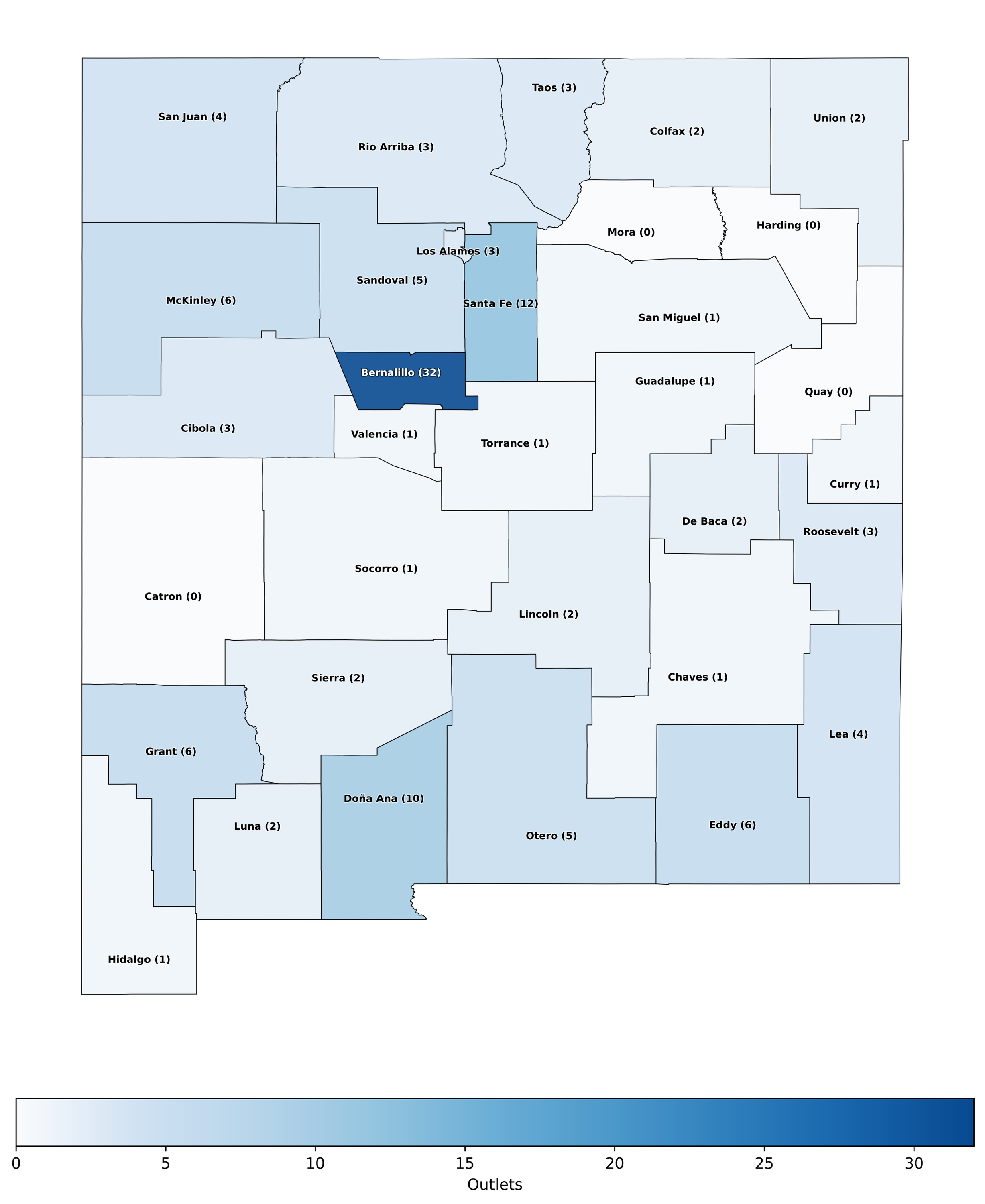
This map shows how local news outlets are concentrated in the most populated counties of Bernalillo, Santa Fe and Doña Ana. Meanwhile, four counties have no local news outlets; eight have only one.
It’s a reminder that access to news isn’t evenly spread, and some communities are left with very little coverage of the issues that matter most to them.
-

Counties with higher populations, like Bernalillo (Albuquerque), Doña Ana (Las Cruces), Sandoval (Rio Rancho), and Santa Fe, have a stronger local news presence.
-
Eight counties only have one outlet—even places with decent population size, like Valencia and Chavez.
-

Four of the smallest counties—Catron, Harding, Mora, and Quay—have no local outlets at all.
Broadcast Coverage Challenges in New Mexico
New Mexico’s geography and population distribution create unique challenges for local broadcast coverage. Radio can be a powerful solution, given its broad reach; however, the vast majority of radio stations in New Mexico do not produce original, local news. Television, on the other hand, provides a significant amount of news coverage, but the stations are concentrated in Albuquerque and dwell on news from the metro area. Rural residents, especially those in eastern and southern New Mexico, often find that much of their TV news originates from Texas.
Southern New Mexico: Many communities are included in the El Paso media market, meaning their primary broadcast news comes from Texas rather than New Mexico. This often limits coverage of state-level policies, elections, and local issues that directly affect these residents.
Eastern New Mexico: Several counties are tied to the Lubbock and Amarillo markets in Texas. Residents there may find themselves with little to no consistent access to in-depth coverage of New Mexico’s legislature, schools, or public services.